
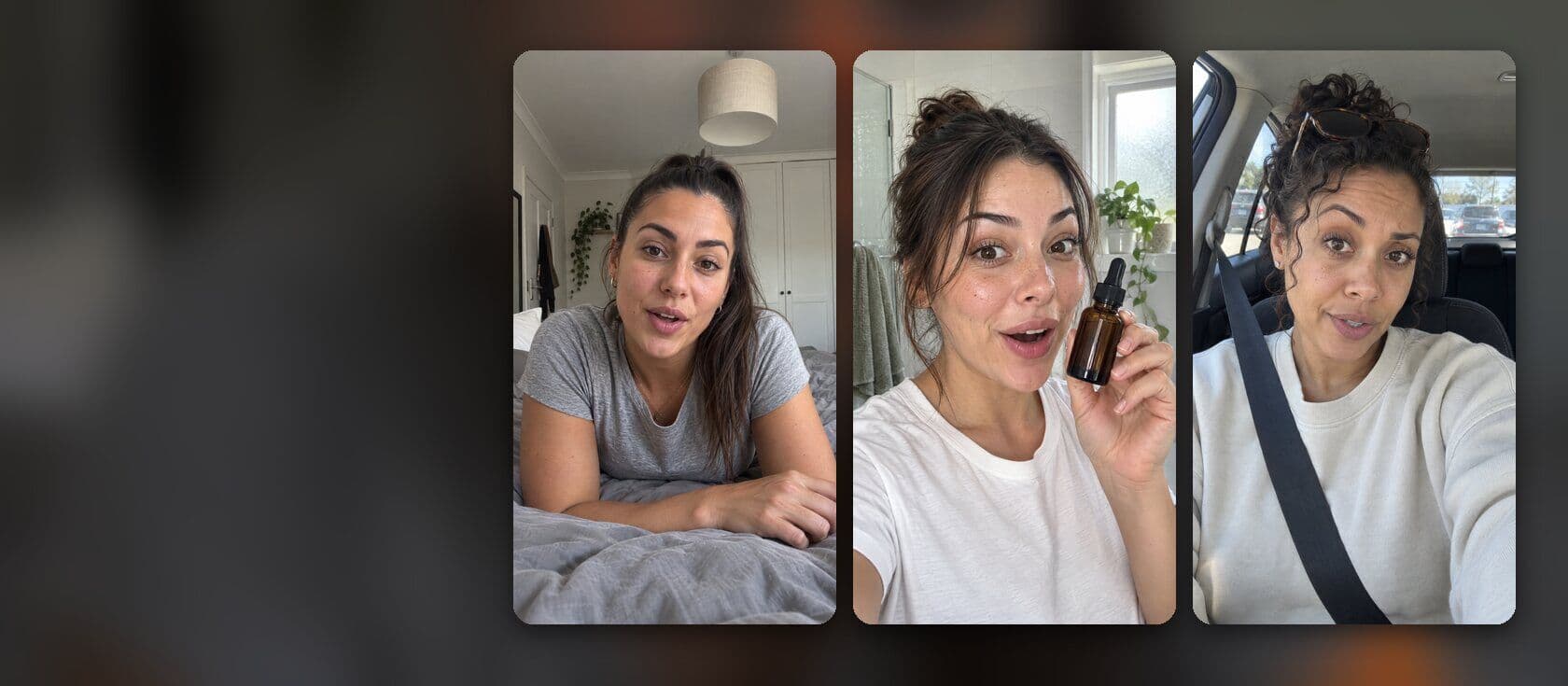
UGC ads: one person, one phone, one take
The longest-running ad from the AI video tools we studied ran for almost four months: a person on camera, a claim, proof, a short demo, a call to action. We made a batch of 41 ads, many in this style, and wrote down what made them work and what made them look fake.
What a UGC ad is
A person talks to their phone as if they are telling a friend: in bed, in the car, on the couch, at work. The ad is 8 to 18 seconds long and does not look like an ad. The person is the hook, and the product appears as something they use.
Cast for realism
Cast ordinary-looking people, about a 6 or 7 out of 10, in real places with real light: a messy bun and a hoodie at night, a seat belt in a parked car, a lamp by the bed. Very attractive people read as AI. Give the eye something to hold, such as a serum bottle or a coffee cup. A real object draws attention away from the face.
Write the line
One plain sentence that says what the product does and one plain instruction, said fast. For example: “Okay, if you want ads that look this real, you have to check out this app.” Talk to the person the viewer wants to become, not to their problem: “How did you lose the weight in 6 months?” beats “Are you struggling with your weight?” Speech runs 2.5 to 4 words a second, so 30 words need about 10 seconds.
Make it in ViewPress
Attach a photo of your product, then type: “Make a UGC ad for my serum. A woman, 26, ordinary-pretty, messy bun, oversized hoodie, on her bed at night, filming herself with the front camera, warm lamp. One take. She says: ‘Okay, I have to show you this serum, my skin has never looked like this.’ Show a comment at the start that says ‘wait what are you using??’” The agent makes the start frame first. Check the face and the product before you approve it: everything in that frame carries into the clip.
A hook at the first frame
The hook must be readable in the very first frame. Two kinds work. A comment card: a question in lowercase that looks like a real comment, such as “how are your ads so good??”. The Comment tab places it. Or a short text statement with no box behind it: “I can’t believe it took me so long to find this.” A slight push-in at 3 to 5 seconds, where most viewers drop off, earns a few more seconds.
Pitfalls
One long take: a realistic talking scene holds its lip-sync best at about 7 seconds or less, so split longer lines. Clever dialogue: be direct. Text on black boxes, and captions of single random words: use phrases of 2 to 4 words. Fake proof: no invented view counts, no invented reviews, no real brands or logos in the frame.
Frequently asked
What other formats are in this family?
A podcast clip with two hosts trading lines and a cutaway between them. A founder talking to the camera. A presenter on a green screen in front of examples. A “censored” hook that bleeps the product name until the reveal. Ask for any of them by name.
How many versions should I make?
Many. Keep the middle and change the hook and the person. Make the hook and the call to action their own scenes, so each new version changes one scene.