
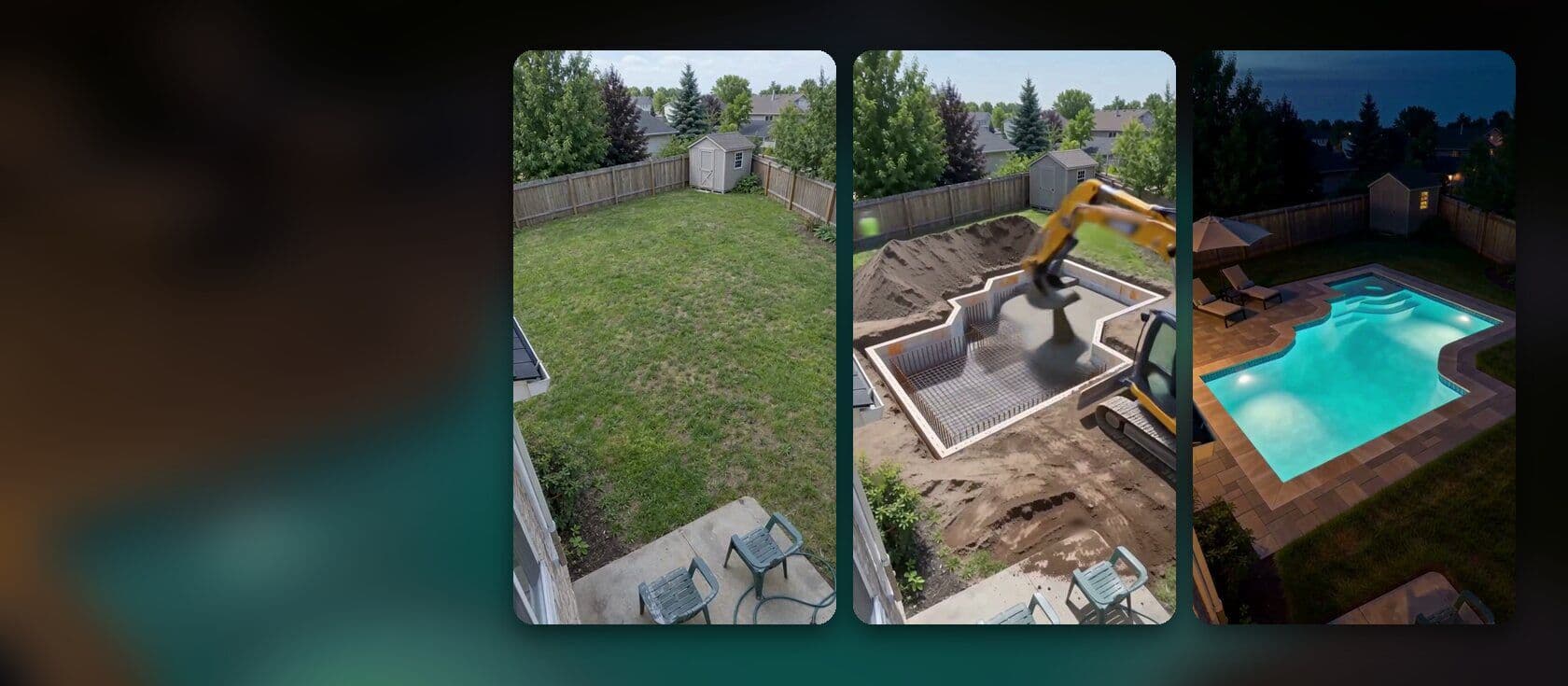
Timelapses and satisfying builds
One app’s tutorial for an AI construction timelapse reached 19.2M plays on TikTok. People watch to the end because they want to see the finished build. The hard part is making the model build it step by step instead of jumping to the result.
The format
A camera on a tripod watches one place change: a lawn, then a hole, then rebar, then concrete and tiles, then a lit pool at night. Usually one worker does all the work. Each step is one clip of about 8 seconds, and the last frame of one clip is the first frame of the next.
Why it works
The end is promised from the first second, so people stay to see it. The sound carries it: shovels, drills, tiles sliding into place, and no music. It needs no voice and no language, so it travels to every country.
Make it in ViewPress
Type: “A timelapse: a backyard lawn becomes a swimming pool over 30 days. A fixed high camera looking down from the house. Four steps: dig, rebar and walls, concrete and tiles, filled and lit at night.” The agent makes the first frame, then makes each step’s end frame as an edit of its start frame, so the camera, the light and the scale stay the same. Each step then becomes one clip that starts on the last frame of the step before.
The prompt that stops jumps
A weak prompt names the action once, and the model jumps to the finished result. A strong prompt says the camera is completely static, at the start and again at the end. It names exactly one worker and his clothes, describes what is already there, says it is an 8-second accelerated timelapse, and spells out the process: he picks up each block, carries it and places it, one at a time, across the whole area. It ends with: “No instant appearance of materials. No teleporting.”
Sound
Put the sound on its own line, name one specific sound for this step, and say no music: “Sound: a shovel cutting into wet soil. No music.” Without that line, the model often adds a music bed.
Pitfalls
More than one worker: they multiply and break the build. A step that brings in different objects, such as furnishing a room: name each item and where it goes, in order. A worker who changes size between clips: give the proportions in every prompt, for example “the worker is about 1.8 m tall and the yard is about 12 m wide.”
Frequently asked
How long is the finished video?
Four to six steps of 8 seconds. Trim the still frames between steps so the build never pauses.
What else works in this format?
Anything with a clear before and after: a bunker fitted out, an overgrown garden cleared, a tiny cabin built, a room tiled. The method stays the same: one place, one worker, one fixed camera.